
커넥셔너리, 한컴위드와 AI 기반 문서 자동 분류 제품 공동 개발
문서의 맥락을 AI가 분석해 기밀·민감·공개(C·S·O) 보안등급과 판단 근거를 제안하고, 등급별 보안정책과 암호화까지 연결하는 제품을 커넥셔너리와 한컴위드가 함께 개발합니다. N2SF 전환을 앞둔 공공기관의 데이터 분류 수요를 겨냥합니다.
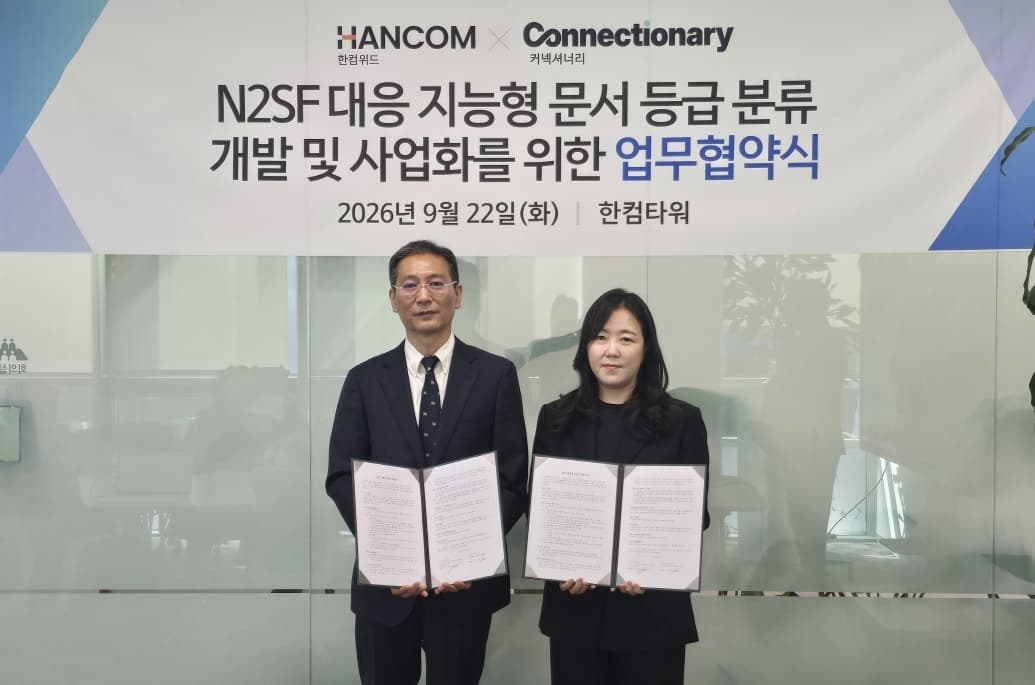
커넥셔너리와 한컴위드가 9월 22일 한컴타워에서 AI 기반 지능형 문서 자동 분류 제품을 공동 개발하기 위한 업무협약(MOU)을 체결했습니다. 양사는 문서의 내용과 맥락을 AI로 분석해 기밀·민감·공개 등 보안등급을 제안하고, 등급별 보안정책과 암호화까지 연결하는 제품을 개발합니다.
이번 협력은 국가 망 보안체계(N2SF) 전환에 대응하기 위해 추진됐습니다. 정부의 망 보안 정책은 데이터의 중요도에 따라 보안 수준을 다르게 적용하는 방향으로 바뀌고 있습니다. 이에 따라 공공기관에는 보유 문서를 C(기밀)·S(민감)·O(공개) 등급으로 분류하고, 각 등급에 맞는 보호조치를 적용할 수 있는 체계가 필요합니다.
문서의 의미와 보안 규정을 함께 분석하는 AI 분류
공동 제품에는 한컴위드의 데이터 보안 태세 관리(DSPM) 기술과 커넥셔너리의 AI 기반 데이터 분류·상태관리 엔진 '클래시피케이션 스튜디오'를 결합할 계획입니다. 조직 내 데이터 자산을 찾고 보안등급을 분류한 뒤, 상태관리와 등급별 보호조치까지 하나의 과정으로 연결하는 것이 목표입니다.
클래시피케이션 스튜디오는 비정형 문서를 의미 단위로 나눠 분석합니다. 실제 문서에 포함된 정보와 보안 규정의 적용 조건을 비교해 C·S·O 등급을 제안하고, 해당 등급으로 판단한 근거도 함께 제시합니다. 담당자는 문서를 하나하나 열어보지 않고도 AI가 제안한 등급과 판단 근거를 효율적으로 검토할 수 있습니다.
분류 이후의 변화도 관리합니다. 데이터나 업무 환경이 달라지면 분류 결과와 판단 근거가 어떻게 바뀌었는지 추적해 문서의 상태를 지속적으로 관리할 수 있도록 설계할 계획입니다.
보안등급 분류에서 정책 적용과 암호화까지 연결
한컴위드는 AI가 제시한 분류 결과를 실제 데이터 보호조치로 연결하는 역할을 맡습니다. DSPM 기술로 조직 내 데이터 자산과 보안 상태를 파악하고, 분류된 데이터에 적합한 보안정책을 적용합니다.
중요 데이터에는 양자내성암호(PQC) 기술을 적용한 데이터 암호화 솔루션 '한컴엑스디비(Hancom xDB)'를 연계합니다. 이를 통해 데이터 탐색부터 보안등급 분류, 상태관리, 정책 적용, 암호화까지 이어지는 체계를 구축할 계획입니다.
N2SF 가이드라인에 맞춘 상용화 추진
양사는 N2SF 보안 가이드라인에 맞춰 공동 제품의 기능을 고도화하고 상용화를 추진합니다. 향후 공공기관을 비롯한 신규 고객을 대상으로 공동 제안과 영업, 마케팅, 기술검증(PoC)도 진행할 계획입니다.
"담당자가 판단 근거를 쉽게 확인하고 데이터와 업무 환경의 변화에 따라 분류 근거와 상태 변화를 지속적으로 관리할 수 있도록 하겠다. 조직이 보유한 정보에 대한 가시성을 높이고 N2SF에 대응하는 일관되고 추적 가능한 데이터 분류 체계와 지속적인 정보 관리 기반을 만들어가겠다."
이지원 · 커넥셔너리 대표
"N2SF 전환에 따라 문서의 문맥을 정확히 이해하고 보호하는 지능형 데이터 보안의 중요성이 커지고 있다. 양사의 전문성을 결합해 보안 규제를 충족하면서도 데이터를 안전하게 관리할 수 있는 솔루션을 제공하겠다."
송상엽 · 한컴위드 대표
언론 보도
Structure before inference
Intelligence that computes,
not just retrieves.
Structured state preserves relationships, conditions, timelines, and evidence across fast-changing technology domains before inference begins.
Connectionary and HancomWITH to Co-Develop an AI-Powered Document Classification Product
Connectionary and HancomWITH will co-develop an AI-powered product that analyzes document context, recommends C (Classified), S (Sensitive), or O (Open) security levels with supporting rationale, and links each classification to security policies and encryption, helping public institutions prepare for South Korea's N2SF transition.
Connectionary and HancomWITH signed a memorandum of understanding on September 22 at Hancom Tower to jointly develop an AI-powered intelligent document classification product. The product will analyze document content and context, recommend security levels such as classified, sensitive, or open, and connect each classification to appropriate security policies and encryption.
The collaboration is designed to address demand arising from South Korea's transition to the National Network Security Framework, or N2SF. As government network security policy shifts toward applying different levels of protection based on data importance, public institutions will need systems that can classify documents as C (Classified), S (Sensitive), or O (Open) and apply corresponding safeguards.
Combining contextual AI classification with DSPM
The joint product will combine HancomWITH's Data Security Posture Management technology with Classification Studio, Connectionary's AI-powered data classification and status management engine. The companies aim to create an integrated workflow that discovers organizational data assets, assigns security classifications, manages changes in status, and applies controls based on each classification.
Classification Studio divides unstructured documents into semantic units and compares the information contained in each document against the conditions defined by applicable security rules. It then recommends a C, S, or O classification and provides the rationale behind the decision, so that staff can efficiently review the recommended classifications and their rationale instead of opening every document one by one.
The product is also designed to track changes in document classifications and their supporting rationale as data and operating conditions evolve, providing a continuing record of document status.
Connecting classification to security controls and encryption
HancomWITH will link the AI-generated classifications to data protection measures. Its DSPM technology will identify data assets and their security status across an organization, then apply policies appropriate to each classified dataset.
The product will also integrate Hancom xDB, HancomWITH's data encryption solution using post-quantum cryptography. The companies plan to connect data discovery, security classification, status management, policy enforcement, and encryption within a single process.
Commercialization aligned with N2SF guidelines
Connectionary and HancomWITH plan to further develop the product in alignment with N2SF security guidelines and pursue commercialization. They also plan to conduct joint proposals, sales, marketing, and proof-of-concept projects for new customers, including public institutions.
"We will enable staff to review the rationale behind each decision and continuously manage changes in classification rationale and status as data and working environments evolve. Our goal is to improve visibility into organizational information and establish a consistent, traceable data classification system and an ongoing information management foundation for N2SF readiness."
Jiwon Lee, CEO of Connectionary
"With the transition to N2SF, intelligent data security that accurately understands and protects the context of documents is becoming increasingly important. By combining the expertise of both companies, we will deliver a solution that meets security regulations while managing data securely."
Sangyeop Song, CEO of HancomWITH
Media Coverage
Structure before inference
Intelligence that computes,
not just retrieves.
Structured state preserves relationships, conditions, timelines, and evidence across fast-changing technology domains before inference begins.